Nutrition in Plants

Do plants go on a diet? Do they have to bother about the kind of nutrition that they are taking? If you have ever wondered about how nutrition in plants occurs, then you are at the right place. Dive in to extract more information!
Do plants go on a diet? Do they have to bother about the kind of nutrition that they are taking? If you have ever wondered about how nutrition in plants occurs, then you are at the right place. Dive in to extract more information!
Nutrition in Plants
Every living organism needs some kind of energy and nutrient materials to ensure that the life processes go on smoothly. Moreover, this energy requirement is got from the food. You can understand this better in animals and human beings as you see it on a daily basis. You very well know what happens if you skip breakfast or lunch! But what about plants? Do they require any nutrition at all?

Every living organism needs some kind of energy and nutrient materials to ensure that the life processes go on smoothly. Moreover, this energy requirement is got from the food. You can understand this better in animals and human beings as you see it on a daily basis. You very well know what happens if you skip breakfast or lunch! But what about plants? Do they require any nutrition at all?

Browse more Topics under Life Processes
Plants and their Nutrition Requirements
Plants are also living things that need some form of energy. They have cells and tissues. They also grow in size and girth. And they are the producers of the ecosystem. So, in order to synthesize food, they do have nutrient requirements. Of course, the kind of nutrient requirements varies.
This kind of nutrition in plants is called the autotrophic mode of nutrition. What does this actually mean? It means that plants have the special capability to make their own food, by using simple inorganic substances to produce organic molecules/substances. They get the energy sources from non-living things such as sun and carbon dioxide.
Plants also have chlorophyll in them, the green colour pigment. With the help of all these above factors, plants can produce simple carbohydrates. The carbohydrates thus produced are utilized by the plant and gives it energy. When there is an excess of carbohydrates in the plants, then it is stored as a reserve for later use.
Types of Autotrophic Nutrition
According to the type of energy source used, autotrophic nutrition in plants can be of two types. They are Photo-autotrophic nutrition (where sunlight is the energy source) and Chemo-autotrophic nutrition (where chemicals are the energy source).
Learn more about the Nutrition in Animals.
According to the type of energy source used, autotrophic nutrition in plants can be of two types. They are Photo-autotrophic nutrition (where sunlight is the energy source) and Chemo-autotrophic nutrition (where chemicals are the energy source).
Learn more about the Nutrition in Animals.
The Process of Photosynthesis in Autotrophs/Plants
To put it simply, plants require certain raw materials, in order to make their own food. These raw materials include carbon dioxide, water, and sunlight. Plants get water from the soil that enters through the roots. And sunlight is the source of energy. But how does carbon dioxide enter the plants? You should first understand that carbon dioxide is a gas.
You have learned in your earlier classes that plants have openings called stomata. Guard cells surround these stomata. These stomata are the openings through which carbon dioxide enters the plants. Gaseous exchange i.e. the exchange of carbon dioxide and oxygen in plants occurs through these stomatal openings.
Water is also lost through the transpiration process through these openings. And hence, when the carbon dioxide requirement is met with for photosynthesis, plants close the stoma.

The above equation shows the chemical reactions that occur during photosynthesis.
Chlorophyll is present in structures called chloroplasts. They are disc-shaped organelles that are present in the mesophyll cells of the leaves. These help in trapping the sunlight within the plant. As the carbon dioxide enters the plant through the stoma, the light energy converts into chemical energy, by the splitting of the water molecules of the plants. Simple carbohydrates are produced in this process. Oxygen is a byproduct of photosynthesis.
In this way, plants are able to take up simple inorganic substances and convert them into simple carbohydrates, to meet their nutrient requirements.

An Introduction
To put it simply, plants require certain raw materials, in order to make their own food. These raw materials include carbon dioxide, water, and sunlight. Plants get water from the soil that enters through the roots. And sunlight is the source of energy. But how does carbon dioxide enter the plants? You should first understand that carbon dioxide is a gas.
You have learned in your earlier classes that plants have openings called stomata. Guard cells surround these stomata. These stomata are the openings through which carbon dioxide enters the plants. Gaseous exchange i.e. the exchange of carbon dioxide and oxygen in plants occurs through these stomatal openings.
Water is also lost through the transpiration process through these openings. And hence, when the carbon dioxide requirement is met with for photosynthesis, plants close the stoma.
The above equation shows the chemical reactions that occur during photosynthesis.
Chlorophyll is present in structures called chloroplasts. They are disc-shaped organelles that are present in the mesophyll cells of the leaves. These help in trapping the sunlight within the plant. As the carbon dioxide enters the plant through the stoma, the light energy converts into chemical energy, by the splitting of the water molecules of the plants. Simple carbohydrates are produced in this process. Oxygen is a byproduct of photosynthesis.
In this way, plants are able to take up simple inorganic substances and convert them into simple carbohydrates, to meet their nutrient requirements.

An Introduction
Plants are like all other living things. They also need food for their growth and development. For the survival of the plants, they also require 16 essential elements. Some of these elements are Carbon, Hydrogen, and Oxygen, which are derived from the atmosphere and soil water.
There are also thirteen essential elements, such as nitrogen, phosphorus, calcium, potassium, magnesium, iron, sulfur, manganese, zinc, copper, boron, molybdenum, and chlorine. These elements are provided either from soil minerals and soil organic matter or by organic or inorganic fertilizers.
To utilize these nutrients efficiently, plants also require light, heat, and water. These factors must be adequately supplied. In crop production, some of these factors play important roles such as cultural practices and control of diseases and getting rid of insects.

Modes of Nutrition
We can define nutrition as it is the procedure of gaining food and applying it to grow, repair any damaged body part, and stay healthy. Some processes are involved in the nutrition of plants as they produce their food by taking raw materials from their surroundings, such as minerals, carbon dioxide, water, and sunlight.
The Two Modes of Nutrition are:
Autotrophic – Plants are called the primary producer as they exhibit autotrophic nutrition. Also, plants synthesize their food by using light, carbon dioxide, and water.
Heterotrophic – Under this category, animals and human beings are included as they depend on plants for their food.

Plant Nutrients
For plant nutrition, some major sources are there. A plant converts the atmospheric CO2 into simple sugar by using the energy of the sun. Carbon dioxide (CO2) enters through the stomata. Oxygen (O2) is also a product of photosynthesis. It is an atmospheric component that also moves through the stomata.
In plants, oxygen is used in cellular respiration to release energy from the chemical bonds in the sugar to support growth and maintenance in the plant. The only reason is that CO2 and light energy are not sufficient for the synthesis of all the molecules a plant needs.

It is also proven that plants require many inorganic nutrients. We call these elements macronutrients. These organic nutrients are required for the plants in relatively large amounts. Other micronutrients are also required in trace amounts.
Scientists have collected around nine macronutrients, such as Carbon, Hydrogen, and Oxygen, the three elements found in all organic compounds as well as nitrogen.
Soil
Soil composition plays an important role in a plant’s growth. We can define the soil as it is the highly weathered outer layer of the earth’s crust.
Soil is made of a mixture of ingredients, which may include sand, rocks of various sizes, clay, silt, hummus, and various other forms of mineral and organic matter. Also, some pore spaces are there containing water, and air occurs between the particles.
Nitrogen Nutrient Functions
Nitrogen is an important nutrient for plants. It is biologically combined with C, H, O, and S to create amino acids, which are the building blocks of proteins.
Plants are using the amino acids to form protoplasm, the site for cell division, and thus for plant growth and development.
Nitrogen is desired for all the enzymatic reactions in a plant as all the plants’ enzymes are made of proteins.
N is necessary for photosynthesis as it plays a major part in the chlorophyll molecule.
To form several vitamins in plants during photosynthesis, N is the necessary component for them.
Nitrogen helps the plant to improve the quality and quantity of dry matter. They are available in leafy vegetables and protein in grain crops

Phosphorus Nutrient Functions
P plays a major role in photosynthesis and respiration. It also helps in energy storage and transfers them as ADP, ATP (adenosine di-phosphate and biphosphate), DPN, and TPN (di - phosphotyrosine and tri - phosphotyrosine nucleotide).
RNA and DNA structures are the major components of genetic information. P helps the plants to carry the genes.
P is found in seeds with the highest concentration in a mature plant. A huge amount of P is required in young cells, such as shoots and root tips as in here, the metabolism is high, and cell division is rapid.
Phosphorus takes part in root development, flower initiation, and seed and fruit development.
Phosphorus helps to reduce disease probability among some plants. It has been found to improve the quality of certain crops.
Do You Know?
We have found some awesome facts about plants. A plant is unique and has an optimum nutrient range as well as a minimum required level. When the plants reach a minimum level, then they start to show nutrient deficiency symptoms.
Too much consumption of nutrients can also cause poor growth because of toxicity. That is why the appropriate amount of application and placement of the nutrients is vital.

Autotrophic Nutrition in Plants
Photosynthesis is a mechanism that allows plants to manufacture their nourishment.
Photosynthesis takes place in the chloroplast.
The majority of food production takes place in leaves. The root absorbs water and nutrients from the soil and transports them to the leaves through vessels. Stomata, which are microscopic holes on leaves bordered by guard cells, allow carbon dioxide to access the leaves.
Chlorophyll is a green pigment found in leaves that aids in the collection of energy from the sun for the leaves to prepare their meal. Photosynthesis is the process of food creation that occurs in the presence of sunshine. As a result, all living species rely on the sun as their principal source of energy.
In the presence of sunshine, water and carbon dioxide are utilised to build carbohydrates and oxygen during photosynthesis. All living things get their sustenance via photosynthesis.
Essential Nutrients for Plants
Plants require particular elements or compounds known as plant vital nutrients to grow, develop, and produce at their optimum.
A plant lacking an important nutrient will not be able to complete its life cycle—the seed will not germinate; the plant will not be able to form adequate roots, stalks, leaves, or flowers; and it will not be able to generate seeds to make new plants. Frequently, the plant will perish.
Too much of a nutrient, on the other hand, can damage or even kill plants. Too much nitrogen, for example, might lead a plant to produce more leaves but less or no fruit. If the leaves are exposed to too much manganese, they will turn yellow and finally die. Furthermore, too much boron can kill a plant.
Conditions Required for Photosynthesis:
Sunlight
Water
Carbon dioxide is a greenhouse gas
Chlorophyll
Photosynthesis is Broken Down into Several Steps:
The process of absorbing energy from the sun.
Light energy is converted into chemical energy.
Water is broken down into oxygen and hydrogen through hydrolysis.
Chemical energy is used to convert carbon dioxide to glucose.
 Plants with Heterotrophic Nutrition

Some plants lack chlorophyll and rely on other plants for nourishment, which is known as the heterotrophic mode of feeding. Heterotrophic nutrition in plants is what these types of nutrition are termed, and parasites are what they are named.
Heterotrophic Plants
Different varieties of heterotrophic plants are listed below, which are mostly categorised depending on their style of nutrition:
Parasitic
Insectivorous
Saprophytic
Symbiotic
Parasitic Nutrition
Some heterotrophic plants rely on the sustenance of other plants and animals. Parasitic plants are those that feed on other plants. The parasite, on the other hand, does not help the host.
Example - Cuscuta, Cassytha, etc.
Plant nutrients in the soil
Soil is a major source of nutrients needed by plants for growth. The three main nutrients are nitrogen (N), phosphorus (P) and potassium (K). Together they make up the trio known as NPK. Other important nutrients are calcium, magnesium and sulfur. Plants also need small quantities of iron, manganese, zinc, copper, boron and molybdenum, known as trace elements because only traces are needed by the plant. The role these nutrients play in plant growth is complex, and this document provides only a brief outline.
Major elements
Nitrogen (N)
Nitrogen is a key element in plant growth. It is found in all plant cells, in plant proteins and hormones, and in chlorophyll.
Atmospheric nitrogen is a source of soil nitrogen. Some plants such as legumes fix atmospheric nitrogen in their roots; otherwise fertiliser factories use nitrogen from the air to make ammonium sulfate, ammonium nitrate and urea. When applied to soil, nitrogen is converted to mineral form, nitrate, so that plants can take it up.
Soils high in organic matter such as chocolate soils are generally higher in nitrogen than podzolic soils. Nitrate is easily leached out of soil by heavy rain, resulting in soil acidification. You need to apply nitrogen in small amounts often so that plants use all of it, or in organic form such as composted manure, so that leaching is reduced.
Phosphorus (P)
Phosphorus helps transfer energy from sunlight to plants, stimulates early root and plant growth, and hastens maturity.
Very few Australian soils have enough phosphorus for sustained crop and pasture production and the North Coast is no exception. The most common phosphorus source on the North Coast is superphosphate, made from rock phosphate and sulfuric acid. All manures contain phosphorus; manure from grain-fed animals is a particularly rich source.
Potassium (K)
Potassium increases vigour and disease resistance of plants, helps form and move starches, sugars and oils in plants, and can improve fruit quality.
Potassium is low or deficient on many of the sandier soils of the North Coast. Also, heavy potassium removal can occur on soils used for intensive grazing and intensive horticultural crops (such as bananas and custard apples).
Muriate of potash and sulfate of potash are the most common sources of potassium.
Calcium (Ca)
Calcium is essential for root health, growth of new roots and root hairs, and the development of leaves. It is generally in short supply in the North Coast's acid soils. Lime, gypsum, dolomite and superphosphate (a mixture of calcium phosphate and calcium sulfate) all supply calcium. Lime is the cheapest and most suitable option for the North Coast; dolomite is useful for magnesium and calcium deficiencies, but if used over a long period will unbalance the calcium/magnesium ratio. Superphosphate is useful where calcium and phosphorus are needed.
Magnesium (Mg)
Magnesium is a key component of chlorophyll, the green colouring material of plants, and is vital for photosynthesis (the conversion of the sun's energy to food for the plant). Deficiencies occur mainly on sandy acid soils in high rainfall areas, especially if used for intensive horticulture or dairying. Heavy applications of potassium in fertilisers can also produce magnesium deficiency, so banana growers need to watch magnesium levels because bananas are big potassium users.
Magnesium deficiency can be overcome with dolomite (a mixed magnesium-calcium carbonate), magnesite (magnesium oxide) or epsom salts (magnesium sulfate).
Sulfur (S)
Sulfur is a constituent of amino acids in plant proteins and is involved in energy-producing processes in plants. It is responsible for many flavour and odour compounds in plants such as the aroma of onions and cabbage.
Sulfur deficiency is not a problem in soils high in organic matter, but it leaches easily. On the North Coast seaspray is a major source of atmospheric sulfur. Superphosphate, gypsum, elemental sulfur and sulfate of ammonia are the main fertiliser sources.
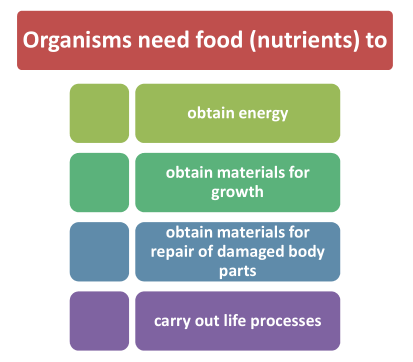
- All living organisms such as plants and animals require food. So food is essential for all living organisms.
- Plants are capable of making their food themselves but humans and animals cannot.
- Carbohydrates, proteins, fats, vitamins and minerals are essential components of food, these components are called nutrients.
Mode of nutrition in plants
- Plants prepare their food by using raw materials like water, carbon dioxide and minerals.
- The process of utilization of food by a living organism to obtain energy is called nutrition.
- There are two modes of nutrition as shown below in the figure
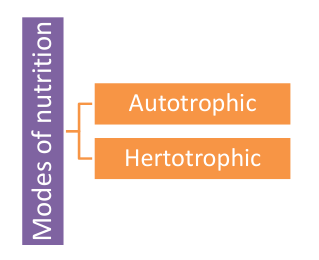
- Autotrophs or Autotrophic: - Plants that have chlorophyll trap the energy from the sun and prepare their own food. Such nutrition wherein the food is prepared by the organisms itself is called autotrophic nutrition. The organisms capable of preparing their own food are called autotrophs. All green plants are Autotrophs (Auto means self and trophos means nourishment). They prepare their own food by a process called photosynthesis.
- Heterotrophs or heterophobic: - Heterotrophic organisms are those who obtain food from other organisms. Since these organisms depend on other organisms for their food, they are called consumers. All animals and non-green plants like fungi come under this category.Organisms that follow the heterotrophic mode of nutrition are called heterotrophs.
Photosynthesis
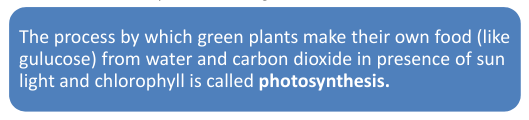
- Photosynthesis is food making process in plants from simple substances like carbon dioxide and water in the presence of sunlight.
- Oxygen is released during photosynthesis.
The process of photosynthesis can be represented as:
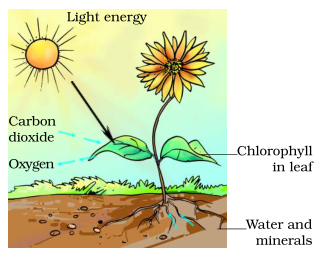
- The process of photosynthesis takes place in the green leaves of a plant.
- The food is prepared by the green leaves of a plant in the form of a simple sugar called glucose.
- The extra glucose is changed into another food called starch. This starch is stored in the leaves of the plant.
- The green plants convert sunlight energy into chemical energy by making carbohydrates.
The photosynthesis takes place in the following three steps:
- Absorption of sunlight energy by chlorophyll.
- Conversion of light energy into chemical energy, and splitting of water into hydrogen and oxygen by light energy.
- Reduction of carbon dioxide by hydrogen to form carbohydrate like glucose by utilizing the chemical energy.
Conditions necessary for photosynthesis:
The conditions necessary for photosynthesis to take place are:
- Sunlight
- Chlorophyll
- Carbon dioxide
- Water
Raw materials for photosynthesis:
The raw materials for photosynthesis are:
- Carbon dioxide
- Water
How the plants obtain carbon dioxide?
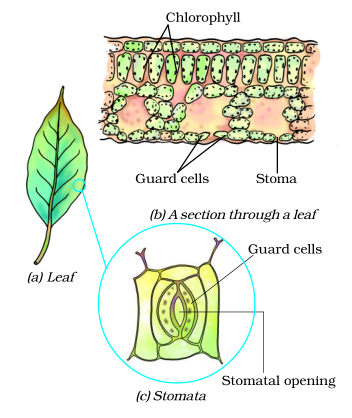
- There are a large number of tiny pores called stomata on the surface of the leaves of plants.
- The carbon dioxide gas enters the leaves of the plant through the stomata present on their surface.
- Each stomatal pore is surrounded by a pair of guard cells. The opening and closing of stomatal pores is controlled by the guard cells.
How the plants obtain water for photosynthesis:
- The water required by the plants for photosynthesis is absorbed by the root of the plants from the soil through the process of osmosis.
- The water absorbed by the roots of the plants is transported upward through the xylem vessels to the leaves where it reaches the photosynthetic cells.
- The plants also need other raw materials such as nitrogen, phosphorus, iron and magnesium, etc., for building their body.
- The plants take these materials from the soil.
- Nitrogen is essential element used by the plants to make proteins and other compound.
Site of photosynthesis: Chloroplasts
- Photosynthesis takes place in the leaves of the plants.
- Leaves have green pigment called chlorophyll
- It helps leaves capture the energy of the sunlight which is then used to prepare food from carbon di oxide and water.
- Here, you see that solar energy is captured by the leaves and is stored in the plant in the form of food.
- So, we can say that Sun is ultimate source of energy for all living organisms.
Other Notes on photosynthesis
- Photosynthesis in plants can also takes place in other green parts like green stems, green branches.
- Glucose (simple carbohydrates) is the simplest food synthesized by plants. This glucose made by plants is converted into complex carbohydrates which are known as starch.
- These simple carbohydrates are used to synthesise other components of food such as proteins and fats.
- Proteins are nitrogenous substances. Plants prepare proteins with the help of nitrogen which is obtained from the soil.
- Plants use the minerals dissolved in water to convert Glucose (simple carbohydrates) into carbohydrates, proteins and fats.
- Photosynthesis is important because
- It provides food to animals including human beings
- It puts oxygen gas into the air which is essential for breathing and respiration in animals including human beings
- It provides food to animals including human beings
- It puts oxygen gas into the air which is essential for breathing and respiration in animals including human beings
Other modes of nutrition in plants(Heterotrophic nutrition)
- Most of the plants have green pigment called chlorophyll and can make their own food.
- Some plants do not have chlorophyll and cannot synthesize their own food and are known as Heterotrophic plants
- This type of nutrition can be categorized into
- parasitic mode of nutrition
- Insectivorous mode
- saprophytic mode of nutrition
- Symbiotic mode of nutrition
- Let us now explain these modes in detail
- parasitic mode of nutrition
- Insectivorous mode
- saprophytic mode of nutrition
- Symbiotic mode of nutrition
Parasites

- In parasitic mode of nutrition, plants depend on other plants or animals for their nourishment.
- Such dependent plants are called as parasites and the ones on which parasites depend are called as hosts.
- A parasite plant climbs on the host plant from which they get all the food.
- The host does not get any benefit from the parasite.
- Some examples of parasites are Cuscuta (akash-bel), Cassytha (amar-bel), hookworms, tapeworms, leeches, etc.
More Notes
- Cuscuta (dodder) is a plant that does not have chlorophyll; it sucks food from the host plant through adventitious roots called haustoria, Cuscuta is therefore a complete parasite.
- Mistletoe plant has green leaves and so can carry out photosynthesis. This plant mainly absorbs water and minerals from the host plant. Therefore, Mistletoe is called a partial parasitic plant.
- Rafflesia is a parasite of the Tetrastigma plant. It is completely dependent on its host plant for food.
Insectivorous Plants
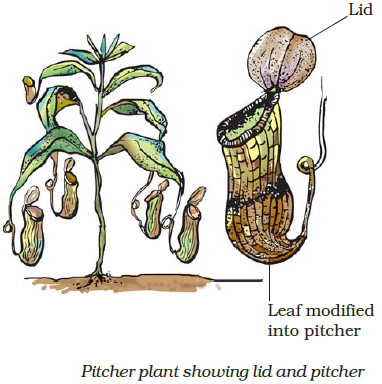
- The insectivorous mode of nutrition is observed in plants like pitcher plant and the Venus fly trap.
- These types of plants purely depend on other insects and small animals for their nutrition.
- Pitcher plants trap small insects inside the pitcher and insects are digested by the digestive juices secreted in the pitcher.
- Insectivorous plants grow in those soils which do not contain sufficient nitrogen mineral.
- These types of plants are green and carry out photosynthesis to obtain a part of food.
More Notes
- The leaves of the Venus flytrap have stiff hair like projections on their edges and the entire leaf is divided into two parts, with the middle acting as a hinge. When an insect sits on the leaf, it shuts tightly, trapping the insect inside it.
- The Pitcher plant has a pitcher- shaped structure filled with liquid. it has a flap -like structure on its mouth. The edge of the opening of the pitcher is slippery. The insect that sits on its slips and falls into the pitcher, getting trapped inside with the closing of the lid.
- The sundew plant has long needle like structures called tentacles covered with sticky substance called mucous. Once an insect sits on it, it gets caught in the mucous and the tentacles fold inward, trapping the insect.
Saprotrophs
- Mode of nutrition in which organisms or plants that obtain their nutrition from dead and decaying organic matter is called Saprophytic mode
- The plants which exhibit saprotrophic mode of nutrition are called as saprotrophs
- Saprotrophs secrete digestive juices onto dead and decaying matter to dissolve it and then absorb nutrients from it.
- Examples of saprotrophs are moulds, mushrooms, yeasts and some bacteria.
Symbiotic plants
- In this mode of nutrition there is a close association between two different plants of different categories.
- In such type of association both the plants get benefited.
- For example certain fungi live in the roots of the trees. In this case tree provides nutrients to fungi and in return receives help from it to take up water and nutrients from the soil.
How nutrients are replenished in the soil
- We know that plants continuously take nutrients from the soil in order to synthesize food. As a result of this amount of nutrients in the soil decreases.
- Nutrients in the soil are replenished by adding fertilisers and manures.
- Fertilisers and manures contain plants nutrients and minerals like nitrogen, phosphorus and potassium.
- Another way to replenish soil is to grow leguminous crops (for example gram, peas, pulses etc.) in the soil.
- The bacterium called Rhizobium can take atmospheric nitrogen and convert it into a soluble form.
- But Rhizobium cannot make its own food. So it lives in the roots of gram, peas, moong, beans and other legumes and provides them with nitrogen. In return plants provide food and shelter to the bacteria.
- Thus plants and bacteria have a symbiotic relationship here.
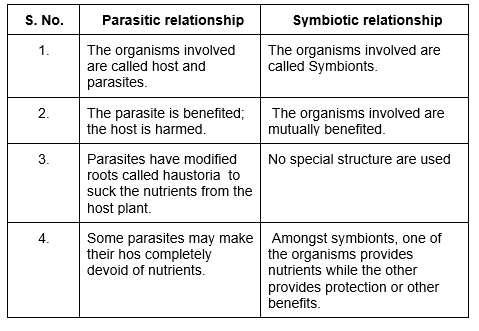
Differences between a parasitic and a symbiotic relationship
Concept Map

Trace elements
| Iron (Fe) | Iron is a constituent of many compounds that regulate and promote growth and is readily available in the North Coast's acid soils. |
|---|---|
| Manganese (Mn) | Manganese helps with photosynthesis. It is freely available in the North Coast's acid soils, often in toxic amounts in very acid soils, but can be deficient in sandy soils. Toxicity is remedied with lime. |
| Copper (Cu) | Copper is an essential constituent of enzymes in plants and is readily available in North Coast soils, although it can be deficient in red soils. Overuse of another trace element, molybdenum, can cause copper deficiency in animals. Toxicity can be a problem for horticulturists who regularly use Bordeaux mixture or copper oxychloride sprays to control diseases on horticultural crops. |
| Zinc (Zn) | Zinc helps in the production of a plant hormone responsible for stem elongation and leaf expansion. It is readily available in acid soils, but combines easily with iron in the North Coast's red soils. This is easily cured with the addition of zinc sulfate or crushed zinc minerals. Fruit trees can be sprayed with zinc. |
| Boron (B) | Boron helps with the formation of cell walls in rapidly growing tissue. Deficiency reduces the uptake of calcium and inhibits the plant's ability to use it. It is chronically deficient in North Coast soils used for horticulture but this is easily remedied with borax applied to the soil. |
| Molybdenum (Mo) | Molybdenum helps bacteria and soil organisms convert nitrogen in the air to soluble nitrogen compounds in the soil, so is particularly needed by legumes. It is also essential in the formation of proteins from soluble nitrogen compounds. Molybdenum deficiency is prevalent in the North Coast's acid soils, but can be remedied easily with applications of Mo super, molybdenum trioxide (applied during inoculation and lime pelleting of legume seed), or sodium molybdate (sprayed on young emerging plants). |
References
- ^ Emanuel Epstein (1972). Mineral Nutrition of Plants: Principles and Perspectives. New York, Wiley. ISBN 9780471243403.
- ^ "Macronutrients and Micronutrients". soilsfacstaff.cals.wisc.edu. Retrieved 2022-07-15.
- ^ Marschner, Petra, ed. (2012). Marschner's mineral nutrition of higher plants (3rd ed.). Amsterdam: Elsevier/Academic Press. ISBN 9780123849052.
- ^ "Archived copy". Archived from the original on 2010-02-19. Retrieved 2010-02-10. Retrieved Jan. 2010
- ^ "Liebig's law of the minimum". Oxford Reference.
- ^ a b c d e f g h i j k Norman P. A. Huner; William Hopkins (2008-11-07). "3 & 4". Introduction to Plant Physiology 4th Edition. John Wiley & Sons, Inc. ISBN 978-0-470-24766-2.
- ^ Pages 68 and 69 Taiz and Zeiger Plant Physiology 3rd Edition 2002 ISBN 0-87893-823-0
- ^ Mia, M.A. Baset. Nutrition of Crop lants. Nova Science Publishers. p. 2.
- ^ a b Swan, H.S.D. 1971a. Relationships between nutrient supply, growth and nutrient concentrations in the foliage of white and red spruce. Pulp Pap. Res. Inst. Can., Woodlands Pap. WR/34. 27 p.
- ^ a b c Roy, R.N.; Finck, A.; Blair, G.J.; Tandon, H.L.S. (2006). "Chapter 3: Plant nutrients and basics of plant nutrition" (PDF). Plant nutrition for food security: a guide for integrated nutrient
Comments
Post a Comment